

76
General
☸️
Nepalese Prayer Wheel
Nepal
A spinning cylinder filled with mantras generates merit and blessings with each rotation, making every turn a complete prayer.
4.7Learn more →


Metal bowls that produce healing resonant tones when struck or rimmed are used for meditation, sound healing, and space purification.
Tibetan singing bowls (also called Himalayan singing bowls or standing bells) are handcrafted metal bowls traditionally made from an alloy of seven metals corresponding to seven celestial bodies — gold (Sun), silver (Moon), mercury (Mercury), copper (Venus), iron (Mars), tin (Jupiter), and lead (Saturn). When struck with a padded mallet or rubbed around the rim, they produce a rich, sustained tone with complex harmonic overtones that continue resonating long after the initial strike. The bowl 'sings' by friction when the mallet is rubbed continuously around its outer rim — a sound that practitioners describe as arising from the bowl itself rather than being imposed on it from outside.
In Tibetan Buddhist practice, singing bowls are used to mark the beginning and end of meditation sessions, to signal transitions in ceremony, and in healing practices where the bowl's vibration is directed toward specific areas of the body or into the space of a room to be purified. The tradition holds that the specific frequencies produced by high-quality singing bowls resonate with the chakra system of the human body, helping to release energetic blockages and restore the body's natural vibrational health. Modern sound therapy practitioners have built entire therapeutic modalities around this principle.
Scientific studies of singing bowl therapy have shown measurable effects on brainwave patterns, heart rate variability, and cortisol levels in practitioners. The complex harmonic overtones produced by the bowls — which can include multiple simultaneous frequencies — have been measured to shift brain activity toward theta and alpha wave states associated with deep relaxation, creativity, and meditation. Whether understood through the lens of traditional Tibetan cosmology or modern neuroscience, the singing bowl's therapeutic effects have substantial empirical support.
Sound as a healing medium, the purification of spaces and bodies through resonant vibration, access to meditative states, and the alignment of personal energy with universal harmony.
Strike the bowl gently to produce the initial tone. To make it 'sing,' press the mallet against the outside of the bowl and move it slowly and steadily around the rim while maintaining consistent pressure. Use before and after meditation. Place a bowl in each corner of a room and strike each one in sequence to energetically clear the space. For sound healing, place the bowl near (not touching) the body area requiring attention.
The oldest singing bowls, dating to approximately the 9th-10th centuries CE, were found in Tibet and the Himalayan region. However, recent research has revealed that functionally identical singing vessel traditions existed in Southeast Asia, China, and India simultaneously — suggesting either shared origins or the independent discovery of the same acoustic principle by multiple cultures.
The traditional method: hold the bowl and strike it, then notice how you feel in your body when hearing the tone. A bowl that resonates with you will produce a sensation of pleasant vibration or relief. Different bowls are traditionally associated with different chakras based on their pitch. Let your physical response guide the selection more than visual appeal.
Hand-hammered antique bowls produce the most complex harmonics because the irregular surface created by hand-hammering creates multiple slightly different vibrating zones that interact to produce rich overtone series. Machine-made bowls are perfectly uniform and produce cleaner but less complex tones. For therapeutic and ceremonial use, hand-hammered is significantly preferred. For simple meditation timing, either works.
Absolutely. Singing bowls are widely used outside Buddhist practice in yoga studios, sound healing practices, mindfulness programs, and personal meditation globally. Their therapeutic effects are based on acoustic physics and psychophysiology, not religious belief. The bowls are among the most accessible of Himalayan spiritual objects for people of all backgrounds.
Nepal
A spinning cylinder filled with mantras generates merit and blessings with each rotation, making every turn a complete prayer.
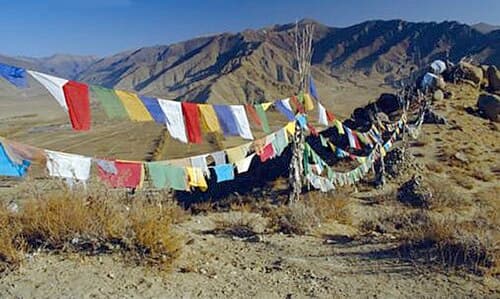
Nepal
Colorful rectangular flags inscribed with mantras and prayers send blessings to all beings as the wind carries their words across the world.

India
A string of 108 prayer beads used for mantra repetition, mala beads align the practitioner's energy with divine intention through meditative counting.
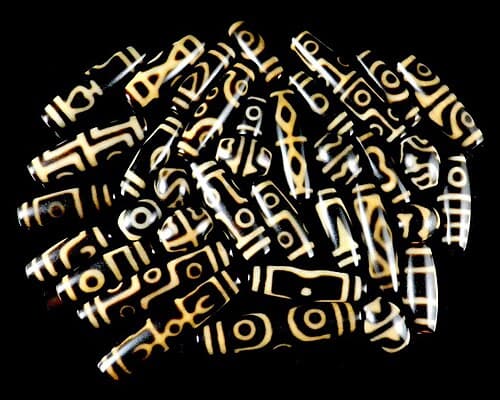
Nepal
Mysterious ancient beads with eye-like patterns are among the most powerful and expensive amulets in Tibetan Buddhist tradition.

