

90
Health
✨
Mexican Milagros
Mexico (Catholic folk tradition)
Small metal votive charms placed on saint statues or shrines to request miracles or give thanks for prayers answered.
4.7Learn more →


The most venerated Catholic image in the Americas — the dark-skinned Virgin who appeared to Juan Diego in 1531, patroness of Mexico and all the Americas.
Our Lady of Guadalupe is the most powerful religious image in the Western hemisphere, the patroness of Mexico, of all the Americas, and of the unborn, venerated by hundreds of millions of Catholics and many non-Catholics alike. According to Church tradition, the Virgin Mary appeared four times to the indigenous Mexican Juan Diego on Tepeyac Hill in December 1531, speaking to him in Nahuatl — his own language — and instructing him to ask the Bishop of Mexico to build a church on the hill. When the Bishop demanded proof, Juan Diego's cloak was miraculously imprinted with the Virgin's image, which still exists and hangs in the Basilica of Our Lady of Guadalupe in Mexico City.
The image's significance extends far beyond conventional Marian apparitions because Our Lady of Guadalupe appeared specifically to an indigenous person, spoke his language, and bore features identified as indigenous rather than European — dark-skinned, dark-haired, and dressed in symbols from both Catholic and Aztec cosmology. She appeared a mere decade after the devastating Spanish conquest, offering a vision of divinity that claimed and dignified indigenous Mexican identity at the precise moment it was being systematically destroyed. Theologians describe her as the church's most successful inculturation — the integration of the divine into a specific cultural context.
Guadalupe medals are among the most widely worn religious jewelry items in North America, kept in wallets, hung in cars, placed on altars, and worn as necklaces by people across the faith and culture spectrum. They are given at baptisms, first communions, weddings, and times of illness or crisis as tokens of the most powerful maternal protection available in the Catholic imagination.
Our Lady of Guadalupe represents divine love that specifically sees and honors the marginalized, maternal protection of incomprehensible scope, and the dignity of indigenous identity within the Christian story. Her medal invokes her specific intercession for the wearer's protection, health, and the fulfillment of heartfelt needs. She is particularly associated with healing, with the protection of the poor and vulnerable, and with the miraculous.
Wear a Guadalupe medal on a chain near your heart, especially during illness, travel, or times of crisis. Place her image on your home altar with fresh flowers — she particularly favors red roses, the flowers that bloomed miraculously in December during Juan Diego's encounters. Pray the traditional prayer to Guadalupe with specific requests and gratitude. Light a candle before her image when seeking her intercession.
The tilma (cloak) of Juan Diego, on which the Virgin's image is imprinted, is made of ayate fiber — a rough cloth that should have degraded completely within 20 years. It has now been preserved for nearly 500 years in the Basilica's climate-controlled display. Scientific examination in 1979 found that the image contains no brush strokes or pigment layering consistent with paint — its physical origin remains scientifically unexplained.
While the medal is specifically a Catholic sacramental, Our Lady of Guadalupe's significance transcends denominational boundaries in Mexican and Mexican-American culture. Many people who are not practicing Catholics wear her image as a cultural identity marker and a request for maternal protection. Her appeal is genuinely universal in the Americas.
In Catholic practice, having religious medals blessed by a priest activates them as sacramentals with specific spiritual power. However, many people wear unblessed medals with profound faith and report significant experiences of protection and answered prayer. The blessing is recommended but not required for the medal to serve as a meaningful protection charm.
December 12th is the Feast of Our Lady of Guadalupe, one of the most widely celebrated Catholic feast days in the Americas. In Mexico, celebrations begin December 9th-11th with pilgrims walking sometimes hundreds of miles to reach the Basilica, with the main feast day involving massive outdoor Masses, music, flowers, and the presentation of Juan Diego figures before the Basilica.
Mexico (Catholic folk tradition)
Small metal votive charms placed on saint statues or shrines to request miracles or give thanks for prayers answered.
Mexico and Philippines (via Spanish colonial tradition)
A figure of the Christ Child dressed in royal garments, venerated as a worker of miracles especially for children and the sick.
Mexico
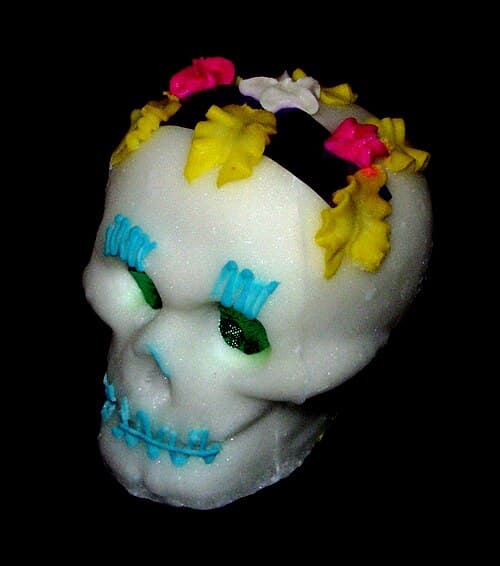
A decorated sugar skull that honors the dead during Día de los Muertos, celebrating the joyful reunion between the living and their beloved ancestors.

