

172
Protection
🏯
Thai Spirit House
Thailand
A miniature dwelling placed outside Thai homes and businesses to house the property's protective spirit and maintain good relations with the spirit world.
4.6Learn more →

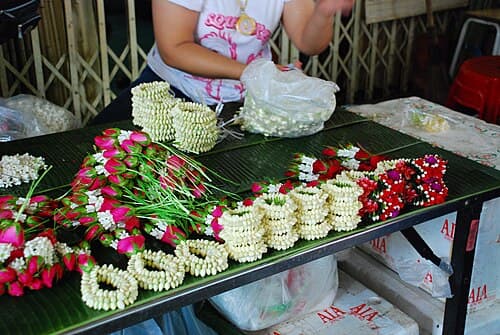
Elaborately knotted flower garlands offered at Thai shrines and given as gifts of blessing and respect.
Phuang Malai (Thai flower garlands) are among the most beautiful and ephemeral of Thai sacred art forms — elaborate strings of fresh jasmine, marigolds, roses, and other flowers knotted and looped into precise patterns, offered at spirit houses, Buddhist shrines, automobile dashboards, and deity statues throughout Thailand. The word 'phuang' means bunch or cluster, and 'malai' means garland, and together they describe an art form that is simultaneously a folk craft, a sacred offering, a gift of respect, and a meditation in impermanence.
The most traditional phuang malai uses jasmine (dok mali) as its primary flower, valued for its pure white color and extraordinary fragrance. Jasmine is specifically associated with respect and reverence in Thai culture — a mother's love, divine purity, and the appropriate offering for the highest deities. Marigolds (dok dao ruang), with their deep orange and yellow colors, add warmth and prosperity energy. The specific combination of white jasmine and orange marigold is the quintessential Thai sacred color pairing, representing the same duality as the Buddhist saffron robe against white temple walls.
The crafting of phuang malai requires considerable skill — the garlands must be knotted tightly enough to maintain their structure while remaining light and airy, and their patterns must be consistent and beautiful. Professional malai makers work with extraordinary speed and precision, producing dozens of garlands in a single morning session before Bangkok's flower markets close. Each garland is complete within hours of creation and begins to wilt by evening, making the offering of a phuang malai a teaching in non-attachment — beauty fully given and fully released.
Respect and honor expressed through living beauty, the offering of fragrance and color to the divine, and the graceful acceptance of impermanence as a spiritual practice.
Offer a fresh phuang malai at shrine entrances, on spirit houses, and at deity statues before making a request. Give a phuang malai as a gift of respect to teachers, elders, and honored guests. Hang a garland in a newly opened car or business as a blessing. Replace garlands before they wilt completely — old, dried garlands should be removed respectfully and fresh ones installed.
Bangkok's Pak Khlong Talat (Flower Market) near the Grand Palace operates 24 hours a day and supplies the majority of Bangkok's temple garlands. The market moves millions of freshly cut flowers daily and represents one of the world's largest single-location fresh flower markets, with the majority of its product going not to homes but to sacred offerings throughout the city.
Jasmine is the most sacred and preferred flower. Marigolds add prosperity and warmth. Crown flowers (dok rak, a lilac flower) are used for royal and formal offerings. Orchids, though beautiful, are considered more ornamental than sacred for garland purposes. Avoid using red roses in garland offerings, as red is associated with blood and may be considered inappropriate for deity offerings in some Thai contexts.
Garlands should be replaced when they begin to wilt visibly, which in Thailand's heat is often daily. Leaving old, wilted garlands on shrines is considered disrespectful — it signals neglect of the deity. Some practitioners follow the rule of replacing garlands every day (lotus garlands in the morning, jasmine in the evening), while less formal offerings may remain for two or three days.
Yes — making your own garland is considered more meritorious than purchasing one because it involves personal effort and care. Basic malai-making requires fresh flowers, a needle, and cotton thread. The simplest form is a straight string of jasmine flowers; the knotted basket form requires practice but is entirely learnable. Many Thai people make simple garlands for home shrines regularly.
Thailand
A miniature dwelling placed outside Thai homes and businesses to house the property's protective spirit and maintain good relations with the spirit world.

Thailand
Thailand's goddess of prosperity and good fortune, Nang Kwak beckons customers and wealth with her raised right hand.

Thailand
The four-faced Brahma deity is Thailand's most widely venerated Hindu god, granting wishes to all who pray with sincere hearts.

India
Rising pure from muddy water, the lotus is the universal symbol of spiritual awakening and untouched beauty across Asia.

