
5
Protection
🖐️
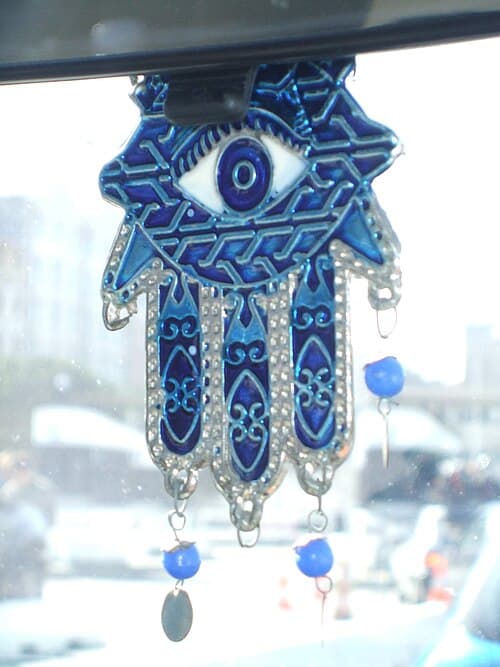
Hamsa Hand
Middle East
An open palm amulet warding off the evil eye across Middle Eastern and North African cultures.
4.9Learn more →

The sacred number five made physical — a numeral-shaped amulet protecting against the five-fingered evil eye.
The number five — khamsa in Arabic, hamesh in Hebrew — holds a uniquely powerful protective significance across the Middle East and North Africa, deriving its talismanic power from its direct connection to the hand (with five fingers) and to the many groups of five that define sacred life in the region. The Khamsa amulet takes the form of the numeral 5, often stylized in Arabic or Hebrew calligraphic script, and is worn or displayed as a direct counter-charm against the evil eye — since the evil eye is cast through another's gaze, and the hand's five fingers are its primary symbol, the number five is the evil eye's most appropriate antidote.
In Morocco the word 'khamsa' is used as a verbal charm as well as a physical one — to ward off misfortune when someone compliments something precious, a Moroccan might say 'khamsa fi ainek!' (five in your eye!) while making the hand gesture, turning the force of any jealous admiration back toward the viewer. This verbal-gestural magic works in tandem with the physical amulet, creating a complete system of protective practice that operates through spoken word, gesture, and carried object simultaneously.
The sacred fives accumulate: five fingers, Five Pillars of Islam, five books of Moses, five daily prayers, five members of the Prophetic family (Ahl al-Bayt), five sacred cities. The Khamsa collects and concentrates all this divine numerology into a single protective symbol, making it one of the most densely charged amulets in the region's talismanic tradition.
Protection against the evil eye through the sacred power of five. The number five acts as a counter-force to envy, a shield woven from the most significant divine numerology of the Abrahamic faiths and pre-Islamic protective tradition.
Wear as a pendant or charm on a bracelet for continuous protection. Say 'khamsa' while making the five-fingered gesture when deflecting unwanted admiration or compliments about precious things. Place in spaces where valuable items are kept or displayed. Combine with other protective amulets for layered defense.
In Tunisia, the hand-shaped khamsa appears on official state emblems and decorative arts dating back to the Phoenician and Carthaginian periods, over 2,800 years ago — making it one of North Africa's longest continuously used protective symbols, predating Islam by many centuries.
They refer to the same protective tradition — 'khamsa' is the Arabic word for five and 'hamsa' is a variant pronunciation. The Khamsa specifically emphasizes the numeral five and its protective power, while 'Hamsa' more specifically refers to the hand-shaped amulet form. They are essentially two aspects of the same protective concept.
The belief is rooted in the idea that the evil eye is cast by someone's envious gaze — their 'eye' — and that asserting the number five (the hand's fingers) repels this gaze. The gesture of the open hand toward the source of the evil eye mirrors this, making the verbal and physical expressions equivalent protective acts.
The word 'khamsa' is especially common in North Africa (Morocco, Algeria, Tunisia) and Egypt, where it is deeply embedded in everyday protective practice. In the Levant (Lebanon, Syria, Jordan, Palestine) and among Jewish communities, 'hamsa' is more commonly used, though the protective concept is identical.
Middle East
An open palm amulet warding off the evil eye across Middle Eastern and North African cultures.
Middle East / North Africa
The sacred open palm named for the Prophet Muhammad's daughter, a cornerstone of Islamic protective symbolism.

Middle East
A blue glass bead charm that reflects the envious gaze before it can cause harm.

