

4
Wealth
🐱
Maneki-neko (Lucky Cat)
Japan
The beckoning cat is Japan's most iconic good-luck charm, believed to wave fortune, customers, and prosperity into any space it occupies.
4.9Learn more →

Every culture on earth has developed its own lucky charm traditions. This guide takes you continent by continent through the most important symbols of fortune worldwide.
One of the most remarkable things about lucky charms is their universality. There is no culture on earth — from the most technologically advanced to the most traditional — that has not developed objects believed to attract good fortune or repel bad luck. While the specific forms vary enormously, the underlying impulse is identical: to carry something tangible that represents hope.
This guide takes you through the most important lucky charm traditions on every inhabited continent.
Japan has one of the richest lucky charm cultures in the world. The Maneki-neko (beckoning cat) is the most internationally famous, but Japanese charm culture extends far deeper. Omamori — small embroidered silk pouches sold at Shinto shrines and Buddhist temples — are perhaps the most actively used charm in modern Japan. Each omamori is dedicated to a specific purpose: academic success, safe childbirth, traffic safety, or romantic fortune. They are replaced annually, as their protective power is believed to expire after one year.
China contributes the feng shui tradition, which has systematized lucky charm placement into a detailed practice. The Money Frog (Jin Chan), Lucky Bamboo, Laughing Buddha, and red envelopes (hongbao) are all central to Chinese prosperity traditions. The number system is critical — eight is the luckiest number, four is avoided at all costs due to its phonetic similarity to the word for death.
South Korea has its own distinct traditions, including Jangseung (carved wooden totem poles placed at village entrances for protection) and Beoseon (traditional socks given as New Year gifts for luck).
India has a deep and complex amulet tradition intertwined with Hinduism, Buddhism, and regional folk practices. Lord Ganesha, the elephant-headed remover of obstacles, is invoked before any new venture. Navaratna (nine-gem) jewelry combines stones representing the nine planetary bodies in Hindu astrology, believed to balance cosmic influences on the wearer.
Thailand is famous for its elaborate amulet culture, where Buddhist monks create talismans blessed with protective prayers. Thai amulet collecting is a serious pursuit, with rare pieces fetching tens of thousands of dollars at specialist markets. The Phra Pidta (monk covering his eyes) and Phra Somdej are among the most valued.
Indonesia and Malaysia share traditions rooted in both Islam and pre-Islamic animism. The keris — a wavy-bladed ceremonial dagger — is believed to possess a spirit (empu) and is treated as a living protective amulet rather than a weapon.
This region is the homeland of three of the world's most powerful amulets: the Hamsa hand, the evil eye bead, and the Hand of Fatima. These symbols are so deeply embedded in daily life that they appear in architecture, jewelry, clothing, car decorations, and even corporate logos.
Turkey is the global center of evil eye bead production, and the Nazar boncuk is arguably the country's most recognizable cultural export. In Morocco, the Hamsa is carved into wooden doors, hammered into brass, and woven into carpets. In Iran, turquoise jewelry is the primary protective amulet, believed to absorb negativity and turn pale when danger approaches.
European lucky charm traditions are remarkably diverse. Ireland claims the four-leaf clover and the leprechaun as its national luck symbols. Italy has the cornicello (little horn), a twisted red pepper-shaped amulet worn to ward off the evil eye (malocchio), and the number 13 is considered lucky, not unlucky.
Germany and Austria celebrate Glucksschwein (lucky pig) figurines, especially at New Year. Scandinavia carries forward Viking-era traditions: the Helm of Awe (Aegishjalmur) and Vegvisir (runic compass) are popular tattoo and pendant designs believed to provide protection and guidance.
Greece maintains an active evil eye tradition, with the mati (blue eye) appearing on everything from baby bracelets to boat prows. Spain has the azabache — a carved jet stone in the shape of a fist — which is pinned to children's clothing as protection against the evil eye.
African lucky charm traditions are vast and deeply spiritual. West Africa has produced powerful talismanic traditions including gris-gris bags (small cloth pouches filled with herbs, prayers, and sacred objects) used in Vodun and related practices. These were carried to the Americas through the slave trade and evolved into the mojo bags of African-American hoodoo tradition.
East Africa has its own traditions: in Ethiopia, the Coptic cross serves as both religious symbol and protective amulet, with over 200 regional variations. In South Africa, the sangoma (traditional healer) creates personalized protective amulets using natural materials aligned with ancestral guidance.
North America blends Indigenous, European, and African traditions. The dreamcatcher (Ojibwe origin) is the most widely recognized Native American lucky charm, designed to filter out bad dreams and let good ones pass through. The rabbit's foot blends Celtic and African-American traditions into one of the most iconic American good-luck objects.
Latin America has incredibly rich charm traditions. Mexico combines pre-Columbian symbols (the Aztec calendar, the jaguar) with Catholic saints and folk magic. Milagros (tiny metal charms shaped like body parts) are pinned to images of saints when praying for healing. Brazil's figa amulet and Candomble spiritual traditions produce a vibrant amulet culture.
Australia's Aboriginal peoples have deep sacred object traditions connected to Dreamtime — these are not typically described as "lucky charms" as the concept is embedded in a more holistic spiritual framework. Polynesian cultures across the Pacific have produced powerful talismanic traditions: tiki carvings in New Zealand represent the first human and serve as protective totems, while Hawaiian ti leaf leis are used for blessing and purification.
Across every continent, the pattern is the same: humans invest physical objects with spiritual significance, carry them for protection and fortune, and pass the traditions to their children. The forms are endlessly diverse, but the impulse is singular. Lucky charms are one of the few truly universal features of human culture.
Japan
The beckoning cat is Japan's most iconic good-luck charm, believed to wave fortune, customers, and prosperity into any space it occupies.
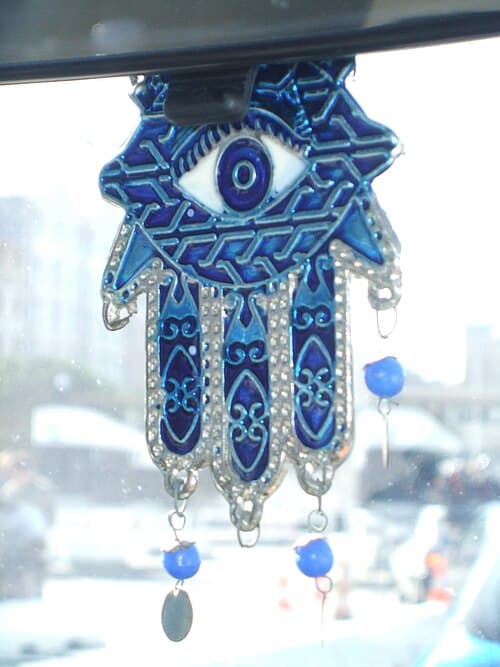
Middle East
An open palm amulet warding off the evil eye across Middle Eastern and North African cultures.

Middle East
A blue glass bead charm that reflects the envious gaze before it can cause harm.

Ireland
The rarest clover mutation, treasured as nature's own lucky charm.

Ojibwe Nation, North America
A woven hoop hung above the bed to filter nightmares and allow only good dreams to pass through.

Egypt
The sacred Egyptian beetle of Khepri, symbol of transformation, rebirth, and the rising sun.
Behind every lucky charm is a tradition of craftsmanship — from Turkish glass-blowing to Japanese papier-mache, discover the artisanal processes that create the world's most beloved talismans.
Psychologists have spent decades studying whether lucky charms have measurable effects on performance. The results are more surprising than you might expect.
Why do intelligent, educated people carry lucky charms? The answer lies in evolutionary psychology, cognitive bias, and the surprising power of illusory control.