

13
Success
🪲
Scarab Beetle
Egypt
The sacred Egyptian beetle of Khepri, symbol of transformation, rebirth, and the rising sun.
4.6Learn more →

From the Eye of Horus to the medieval Seal of Solomon, these ten amulets shaped civilizations, protected armies, and inspired millions across thousands of years.
Throughout human history, certain amulets have risen above mere folk tradition to become symbols of civilizational power — objects believed to protect entire nations, decide the outcomes of wars, and channel divine authority. These are not the gentle good-luck charms of souvenir shops; these are the heavyweights of the amulet world, objects whose influence shaped the course of history.
The Eye of Horus may be the single most influential amulet in human history. Originating in ancient Egypt over 5,000 years ago, this symbol of protection, healing, and royal power was worn by pharaohs, painted on tombs, and carved into temple walls across the entire Nile civilization. The eye represents the restored eye of the god Horus, which was torn out in battle with Set and magically healed by Thoth. Its mathematical properties — the fractions of the eye's components add up to nearly one — led to its use in Egyptian medicine and measurement systems, making it both a spiritual and practical tool.
According to Jewish, Christian, and Islamic tradition, King Solomon possessed a magical ring or seal engraved with the six-pointed Star of David (or, in some versions, the name of God). This seal allegedly gave Solomon the power to command demons, speak with animals, and control the forces of nature. Medieval grimoires — magical handbooks — devoted entire chapters to the Seal of Solomon, and versions of it were carried by Crusaders, Islamic soldiers, and Renaissance magicians alike. The hexagram symbol it bears remains one of the most widely recognized sacred geometric forms in the world.
The scarab was ancient Egypt's most versatile amulet. Representing Khepri, the god of the rising sun and rebirth, scarabs were placed in tombs to ensure resurrection, carried by the living for daily protection, and used as official seals in government and commerce. The scarab's association with the dung beetle — which rolls a ball of dung across the ground just as Khepri was believed to roll the sun across the sky — made it a powerful symbol of creation from apparent nothingness.
In Norse Viking culture, Mjolnir pendants were the most common amulet, worn by warriors, farmers, and merchants across Scandinavia, Iceland, and the Norse diaspora. The hammer of Thor, god of thunder, was believed to protect against chaos and evil, bless marriages, and consecrate sacred spaces. Archaeological finds across Northern Europe consistently uncover Mjolnir pendants, often alongside Christian crosses, suggesting a transitional period when Vikings hedged their spiritual bets.
The Hamsa — an open palm with a protective eye — has been continuously used across the Middle East and North Africa for at least 3,000 years. It is one of the rare amulets that transcends religious boundaries entirely: Jews call it the Hand of Miriam, Muslims call it the Hand of Fatima, and Christians in the Levant associate it with the Virgin Mary's hand. Archaeological evidence of open-hand protective symbols has been found in ancient Carthage, predating both Islam and Judaism in the region.
The ankh, shaped like a cross with a loop at the top, was the ancient Egyptian hieroglyph for "life" and remains one of the most powerful symbols ever created. Only gods and pharaohs were depicted holding the ankh, which was believed to grant immortality. Its influence extends far beyond Egypt — the Coptic Church adopted it as its cross, and it has been reinterpreted by modern spiritual movements worldwide as a universal symbol of eternal life.
The blue glass Nazar bead is arguably the most widely distributed amulet in human history by sheer numbers. Billions have been produced over millennia across Turkey, Greece, Egypt, and the broader Mediterranean world. The belief that an envious gaze can cause harm is documented in virtually every ancient civilization, making the evil eye the closest thing to a universal human superstition. The blue glass counter-amulet has been the primary defense against it for at least 3,500 years.
Among Indigenous peoples of North America, the medicine bundle was the most sacred protective object. Containing personally significant items — feathers, stones, herbs, bone fragments, and offerings — chosen through vision quests and spiritual guidance, each bundle was unique to its owner. Some tribal medicine bundles were believed to protect entire communities and were guarded by designated keepers for generations.
In ancient China, the jade bi disc — a flat, circular jade object with a hole in the center — was one of the most sacred ceremonial amulets. Associated with heaven and immortality, bi discs were buried with rulers to ensure their passage to the afterlife. Some bi discs date to the Neolithic period (3,000+ BCE), making them among the oldest continuously valued amulets in human history. Jade itself was considered more precious than gold in Chinese tradition.
The crucifix — a cross bearing the figure of Christ — is worn as a protective amulet by hundreds of millions of Christians worldwide, making it the most widely carried personal amulet in the modern world. While theologians may distinguish between devotional wearing and superstitious use, the line between faith and lucky charm has always been blurry. Soldiers have carried crucifixes into battle since the Roman era, and the practice of kissing a crucifix for luck before a difficult undertaking remains common across Catholic and Orthodox traditions.
Despite spanning five continents and five millennia, these ten amulets share remarkable common features: they all invoke a power greater than the individual, they all use visual symbols to represent invisible forces, and they all serve the fundamental human need to feel protected in an uncertain world. Their endurance is not evidence of naivety — it is evidence of how deeply embedded the amulet instinct is in human psychology.
Egypt
The sacred Egyptian beetle of Khepri, symbol of transformation, rebirth, and the rising sun.
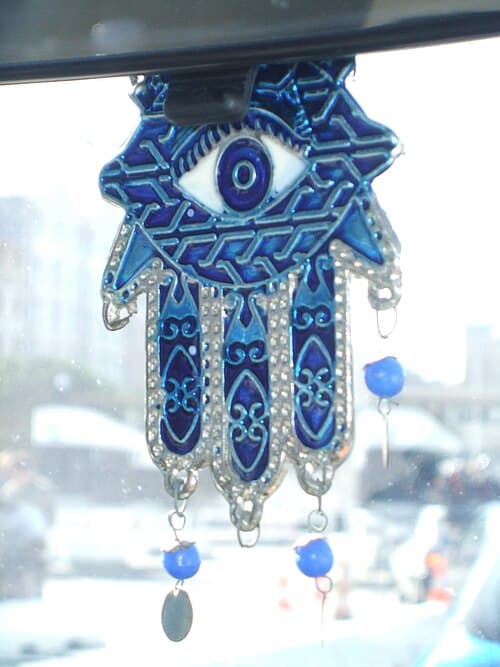
Middle East
An open palm amulet warding off the evil eye across Middle Eastern and North African cultures.

Middle East
A blue glass bead charm that reflects the envious gaze before it can cause harm.

Norway
The mighty hammer of the thunder god, worn as protection across the Viking world.

Egypt
The ancient Egyptian key of life, a symbol of immortality and the union of masculine and feminine forces.
Some lucky charms have transcended their origins to become global celebrities. Discover the stories behind the world's most famous individual charms and their legendary powers.
Trace the extraordinary 5,000-year journey of lucky charms from the tomb-lined corridors of ancient Egypt through Roman amulet markets, medieval pilgrimage routes, and into the digital age.
In Italy, 13 is lucky and 17 is cursed. In China, 4 is feared and 8 is coveted. In many cultures, Friday the 13th is just another day. Explore how different civilisations have constructed entirely different systems of luck — and what that reveals about human nature.