

201
General
📿
Tasbih Prayer Beads
Middle East
Thirty-three or ninety-nine beads used to count the ninety-nine names of Allah and cultivate mindful devotion.
4.7Learn more →


The crescent moon and star, a symbol of Islamic faith found on mosques, flags, and protective amulets across the Muslim world.
The crescent moon and star is the most globally recognized symbol of Islam, appearing on the flags of many Muslim-majority nations, atop mosques and minarets, and in the protective amulets carried by Muslims worldwide. Though it was not originally an Islamic symbol — the crescent and star were used in pre-Islamic Arabia and by the Byzantine Empire — it became so thoroughly associated with Islam through the Ottoman Empire that today the connection is inseparable. The Ottoman Turks adopted the crescent from Constantinople after their conquest in 1453, and as the Ottoman Empire spread across the Middle East and North Africa, the symbol traveled with it.
The crescent moon holds particular significance in Islam because the Islamic calendar is lunar — the sighting of the crescent moon marks the beginning of each month, including the holy months of Ramadan and Dhul Hijja. The crescent is thus a marker of sacred time, and its appearance in the sky during Eid al-Fitr announces the end of Ramadan's fasting and the beginning of celebration. This role as the herald of sacred moments gives the crescent its spiritual weight — it is the eye of the night sky that observes the faithful's devotion and signals divine recognition.
As a protective amulet, the Islamic crescent appears in jewelry, car decorations, and home ornaments across the Muslim world, functioning not as an idol but as a symbol of identity, faith, and the blessing of belonging to the ummah — the global community of believers. It is often paired with the star that represents divine light guiding humanity through the darkness of the world.
Islamic faith, divine guidance, the sacred rhythm of lunar time, and the blessing of community with the worldwide Muslim ummah. The crescent is the marker of sacred beginning — it announces the holy and invites participation in divine time.
Wear as a pendant or bracelet as a declaration of faith and an invitation for divine protection. Hang in a car or home as a reminder of faith amid daily life. Display as a symbol of respect and welcome during Ramadan. Gift to someone at key Islamic life milestones such as first Hajj or marriage.
The red crescent used by Islamic humanitarian organizations (equivalent to the Red Cross) was first officially used by the Ottoman Empire during the Russo-Turkish War of 1877-1878, making it one of the most internationally recognized protective symbols in humanitarian work today.
There is no single official symbol of Islam — the crescent was not used during the Prophet Muhammad's time. It became associated with Islam primarily through the Ottoman Empire. Many Islamic scholars note that Islam as a faith doesn't require symbolic emblems, but the crescent has become a de facto cultural and national symbol for Muslim communities.
The Ottoman influence spread the crescent across its former territories, including North Africa and the Arab world. When former Ottoman territories gained independence, many retained the crescent on their flags as a symbol of Islamic identity and continuity. Countries like Turkey, Tunisia, Pakistan, and others carry this Ottoman legacy in their flags.
The star is often interpreted as representing the light of divine guidance piercing the night, the Five Pillars of Islam (pentagram), or Venus as the morning star of navigational guidance. Different traditions and cultures attach slightly different meanings to the star component.
Middle East
Thirty-three or ninety-nine beads used to count the ninety-nine names of Allah and cultivate mindful devotion.
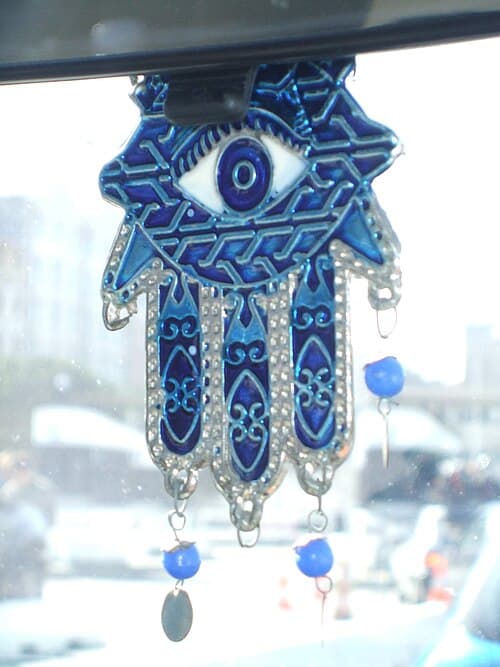
Middle East
An open palm amulet warding off the evil eye across Middle Eastern and North African cultures.
Middle East / North Africa
The sacred open palm named for the Prophet Muhammad's daughter, a cornerstone of Islamic protective symbolism.

